Bortle Dark Sky Scale Converter
Enter an SQM reading or the faintest star you can see to get your Bortle class, from 1 (darkest) to 9 (inner city).
Recent
Your last 10 settings, saved only in this browser. Nothing is uploaded.
How to use the Bortle scale converter
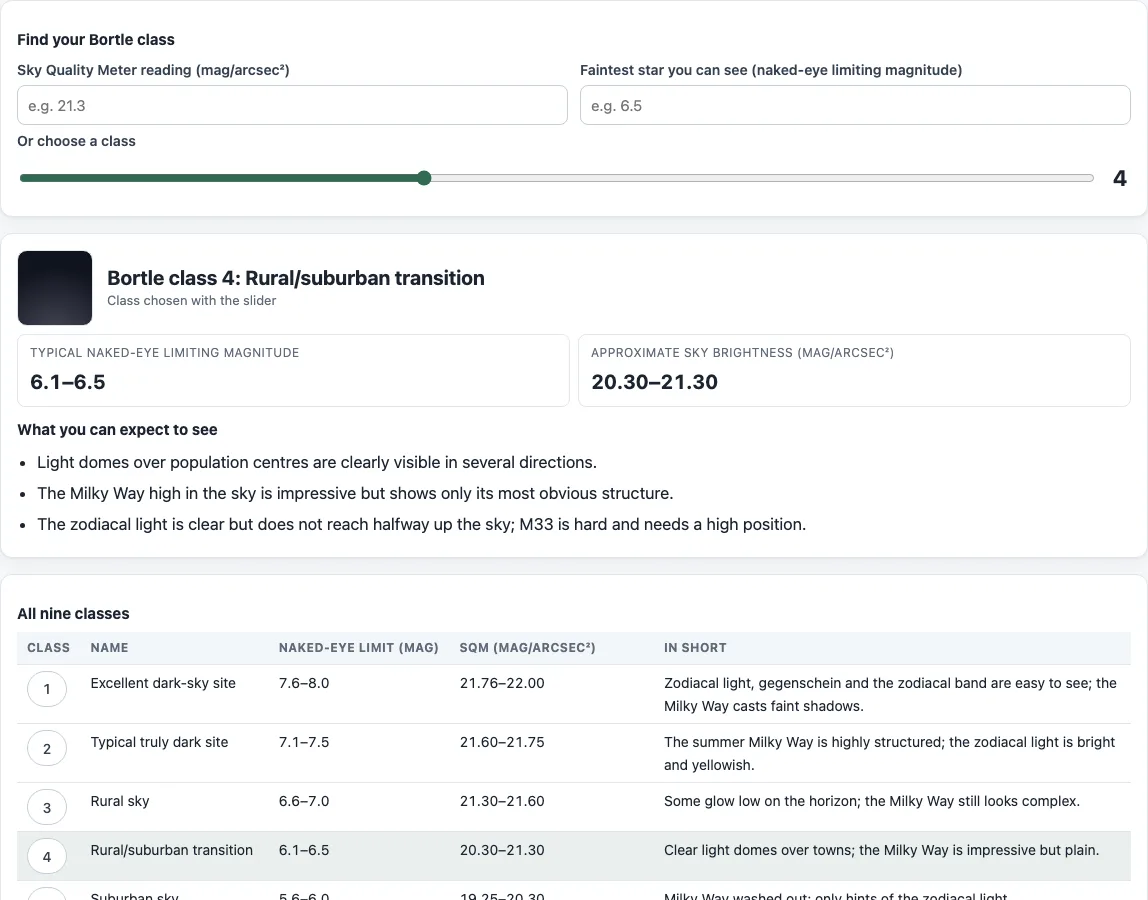
- Find the section named “Find your Bortle class” near the top of the page.
- If you have a Sky Quality Meter, type its reading into “Sky Quality Meter reading (mag/arcsec²)”. Accepted values run from 10 to 25. A bigger number means a darker sky.
- If you do not have a meter, type the faintest star you can see into “Faintest star you can see (naked-eye limiting magnitude)”. Accepted values run from 2 to 9.
- A comma works as a decimal mark, so 20,8 and 20.8 give the same result.
- To skip the readings, move the slider “Or choose a class” to a number from 1 to 9. The big number beside the slider shows the class you picked.
- Read the result card. The heading says “Bortle class N:
”, and a line below it shows where the class came from. The card also shows a sky swatch, the typical naked-eye limiting magnitude, the approximate sky brightness, and three points under “What you can expect to see.” - Check the table “All nine classes” to compare every class. Select a class by clicking its button in the “Class” column.
If a value is outside the accepted range or is not a number, an error line appears under the field. Fix the value and the result updates.
The address bar records your input as sqm=21.3, nelm=6.5 or c=5. Opening the page with the same values gives the same result.
What is the Bortle scale?
The Bortle scale is a nine-level scale of night-sky darkness. Amateur astronomer John E. Bortle published it in Sky & Telescope in February 2001. Class 1 is an excellent dark-sky site, and class 9 is the inner-city sky.
Each class has a name, a naked-eye limiting magnitude, and a description of what you can see. The limiting magnitude is the faintest star you can see without optical aid. A higher number means fainter stars are visible, so the sky is darker. At class 1 the limit is 7.6 to 8.0. At class 9 it is 4.0 or brighter, and apart from the Pleiades, no Messier object is visible to the unaided eye.
Bortle’s article describes what each class looks like and gives no sky-brightness numbers. Sky brightness comes from a Sky Quality Meter, which reads in magnitudes per square arcsecond. A bigger number means a darker sky. Dark Skies Awareness puts the natural, unpolluted sky at about 21.6 at solar minimum. The SQM ranges on this page come from the Dark Skies Awareness Sky Brightness Nomogram conversion, as tabulated when read on 2026-10-13. The nomogram’s own page says its scales are approximate, and other published tables differ by a few tenths of a magnitude.
What Bortle class is my sky?
Find the class whose range contains your reading. For an SQM reading, check the classes from 1 downward. A reading at or above a class’s lower limit gives that class. For example, a reading of 20.8 falls in the 20.30 to 21.30 range, so it is class 4.
For a naked-eye limit, the converter rounds to the nearest published range. The boundaries sit halfway between ranges. A limit of 7.55 or higher reads as class 1, and a limit from 7.05 up to 7.55 reads as class 2.
Treat the result as an estimate. An SQM reading changes with the moon, haze, airglow, the season, and where the meter points. Your naked-eye limit depends on your eyes, your age and your experience. Dark Skies Awareness notes about 6.6 to 6.8 for average observers at an excellent site, and up to magnitude 8 for experienced observers. Take several readings on different nights and compare the results.
Frequently asked questions
What SQM value is Bortle 4?
Bortle 4 is about 20.3 to 21.3 mag/arcsec² in the table used here. Other published tables differ by a few tenths of a magnitude. The table of all nine classes lists every range side by side.
What is the limiting magnitude of Bortle 3?
Bortle 3 has a naked-eye limiting magnitude of 6.6 to 7.0, according to Bortle’s 2001 article. Your own limit depends on your eyes and experience.
What is the best Bortle class for stargazing and Milky Way photography?
Classes 1 to 3 show detailed Milky Way structure. At class 4 it is still impressive but lacks fine structure. From class 6 it is visible only near the zenith, and at class 7 it is nearly invisible.
Is there a Bortle map of the US?
This page has no map. It also does not look up the class of an address, and it has no light pollution map. For measured night-sky data for national parks, see the NPS Night Skies program, linked on the page.
Is a Bortle class 1 sky common?
No. Class 1 skies are rare near cities. Bortle described them as an observer’s Nirvana. At class 1 the zodiacal light is striking, and the Scorpius and Sagittarius parts of the Milky Way cast shadows.
What does an SQM reading below 18.0 mean?
It gives class 8, with a note that the sky could be class 8 or 9. Published tables give no separate SQM figure for class 9. In the table used here, readings below 18 are city skies.
Related tools
- Golden hour calculator: use it to plan the window of soft light before and after sunrise and sunset, which is a different part of the day from stargazing.
- Sunrise and sunset calendar: use it to check sunset times when you plan to observe after dark.
- National parks map: use it to find parks that you might visit for dark skies.
- Campgrounds near me: use it to look for a place to stay near a dark site.
- Travel itinerary template: use it to lay out a trip that includes a night of stargazing.