Camping Checklist Generator
Pick your camping style, nights, people and weather to get a printable camping list you can tick off as you pack.
Recent
Your last 10 settings, saved only in this browser. Nothing is uploaded.
The Camping checklist builds a categorized, printable camping list from your trip. You choose your camping style, nights, people, weather and extras, and the list updates at once. It runs in your browser, is free, and needs no sign-up. Nothing you type is sent anywhere.
The list covers shelter, kitchen, food, water, clothing, hygiene, safety, tools and fun. It starts with the National Park Service Ten Essentials. Tick items as you pack them, then print, download or copy a link to your list. Check campground rules for fires, firewood, pets and food storage before you go. The list reminds you to check them, but it does not state them.
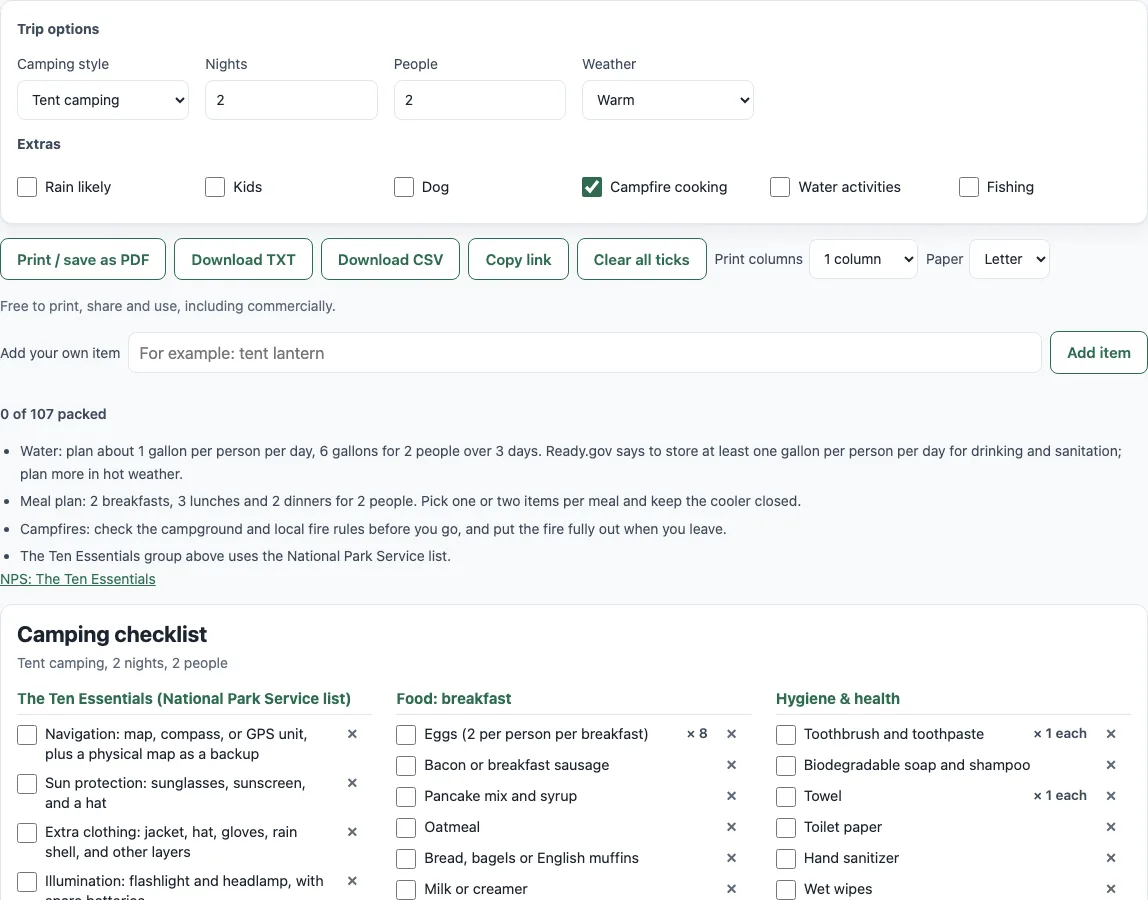
How to use the Camping checklist
- Choose a “Camping style”: Tent camping, Car camping, RV or camper, Cabin or Backpacking.
- Set “Nights” and “People.”
- Pick a “Weather” setting: Warm, Cool or Cold.
- Tick any extras that apply: “Rain likely,” “Kids,” “Dog,” “Campfire cooking,” “Water activities” or “Fishing.” The list updates as you change settings. There is no submit button.
- Tick each item as you pack it. “Your list” shows “N of M packed.”
- Remove lines you don’t need with the x button. Bring them back from “Removed items (N)” with “Put back” or “Put all back.”
- Type an item in “Add your own item” and select “Add item.”
- Select “Print / save as PDF.” Set “Print columns” to 1 or 2 columns and “Paper” to Letter or A4 first.
Select “Download TXT” for a plain text list with [ ] boxes, or “Download CSV” for a file with Section, Item, Quantity and Packed columns. “Copy link” saves your option changes, removed items and your own items in the address, so the same list opens from that link. Ticks stay in this browser only and are not part of the link. Select “Clear all ticks” to start packing again. The output may be used commercially, royalty-free and without credit, but the tool itself may not be copied as a competing service.
How much water do I need for camping?
Plan about 1 gallon of water per person per day. Ready.gov advises storing at least one gallon per person per day for several days, for drinking and sanitation. The tool uses this as a planning figure: people times days, where days equal nights plus one. Two people on a 3-night trip (4 days) get a hint of 8 gallons, and four people on 3 nights get 16 gallons.
Hot weather calls for more water, so treat the hint as a starting point. The water note above the list shows the figure in gallons.
What do I need for tent camping?
Choose “Tent camping” and the list adds shelter and sleep gear, kitchen, food, water, clothes, hygiene, safety, tools and fun lines. Each count then scales with your nights and people. Days equal nights plus one. Breakfasts and dinners equal nights, and lunches equal days. This is the tool’s planning rule. A 3-night trip gives 3 breakfasts, 4 lunches and 3 dinners per person.
Clothing counts are per person. Underwear and socks equal days plus one, capped at 7 so the count stops at a week of laundry. Shirts equal days, capped at 5. Pants or shorts equal half the days, rounded up, within 1 to 4. A 2-night trip for two people gives each person 4 underwear, 3 shirts and 2 pants.
Food quantities are planning hints, not official figures. The tool uses 2 eggs per person per breakfast, 2 hot dogs per person, 1 burger or sausage per person, and 1 snack bar per person per day. For 4 people on a 3-night trip with campfire cooking, that gives 24 eggs and 8 hot dogs. The same group gets 4 sleeping bags.
The list never decides for you: every line can be removed, and anything missing can be added under “Add your own item”, so the same page works for a first night in a tent and for a family that camps every month.
Frequently asked questions
What food should I bring camping?
Turn on “Campfire cooking” to add breakfast, lunch, dinner, campfire treat and pantry lines based on your meal plan. Turn it off for no-cook food. The National Park Service lists extra food, such as no-cook, energy-dense snacks, as part of the Ten Essentials.
What are the Ten Essentials?
The Ten Essentials are a National Park Service list: navigation, sun protection, extra clothing, illumination, first-aid supplies, fire, repair kit and tools, nutrition, hydration and emergency shelter. The tool always shows them as the first group, with 10 lines in NPS wording. The source is the NPS list, last updated May 28, 2026.
What is different for camping in cold weather?
Set “Weather” to Cold. The list adds fleece, thermal layers, wool socks, a warm hat and gloves, an insulated sleeping pad, an extra blanket and hot drinks. Backpacking lists also add a sleeping bag liner.
What is on a backpacking checklist?
Choose “Backpacking” as your camping style. The list drops the cooler, camp stove set, chairs, table, firewood, water jugs and RV items. It adds a backpack, stove, bear-canister line, trowel, freeze-dried dinners and a permit line. With the default settings, the backpacking list has 69 lines, compared with 107 for tent camping. Check permit rules with the land manager before your trip.
Can I print it or add my own items?
Yes. Select “Print / save as PDF” to print or save. To add an item, type it in “Add your own item” and select “Add item.” Your items appear under “Your own items.” You can also select “Download TXT” or “Download CSV.”
Can I use the printable checklist for commercial purposes or sell printables online?
Yes. The tool is free to print, share and use, including commercially. You may use what it produces, such as checklists, in a classroom or in products for sale, royalty-free and without credit. The one limit is that you may not copy the website or tool itself as a competing service.
Related tools
- Campgrounds near me: to find the federal campground before you pack for it.
- RV campgrounds with hookups: when you camp in an RV and need electric or water hookups.
- Road trip packing list: for the car side of the trip: documents, car kit, snacks and kids’ things.
- Travel itinerary template: to write down each day of the trip and where you sleep.
- National parks map: to pick a national park to camp in.
- Golden hour calculator: to time photos at camp around sunrise and sunset.
- Bortle dark sky scale: to judge how dark the sky at a campsite is for stargazing.