Golden Hour Calculator
Pick a national park or a location and a date to get the golden hour and blue hour times, morning and evening.
Recent
Your last 10 settings, saved only in this browser. Nothing is uploaded.
How to use the Golden Hour Calculator
- Choose a place. Open the “National park” list to pick one of the 62 national park units. For any other spot, select “Type latitude and longitude”, then enter a “Latitude (°, north positive)” and a “Longitude (°, east positive; US longitudes are negative)”.
- Or press “Use my location” to fill in your position from your browser.
- Check the “Time zone”. Choosing a park selects that park’s zone. For a custom point, pick one of the US zones or “This device’s time zone”.
- Set the “Date”. It starts on today’s date in the chosen zone.
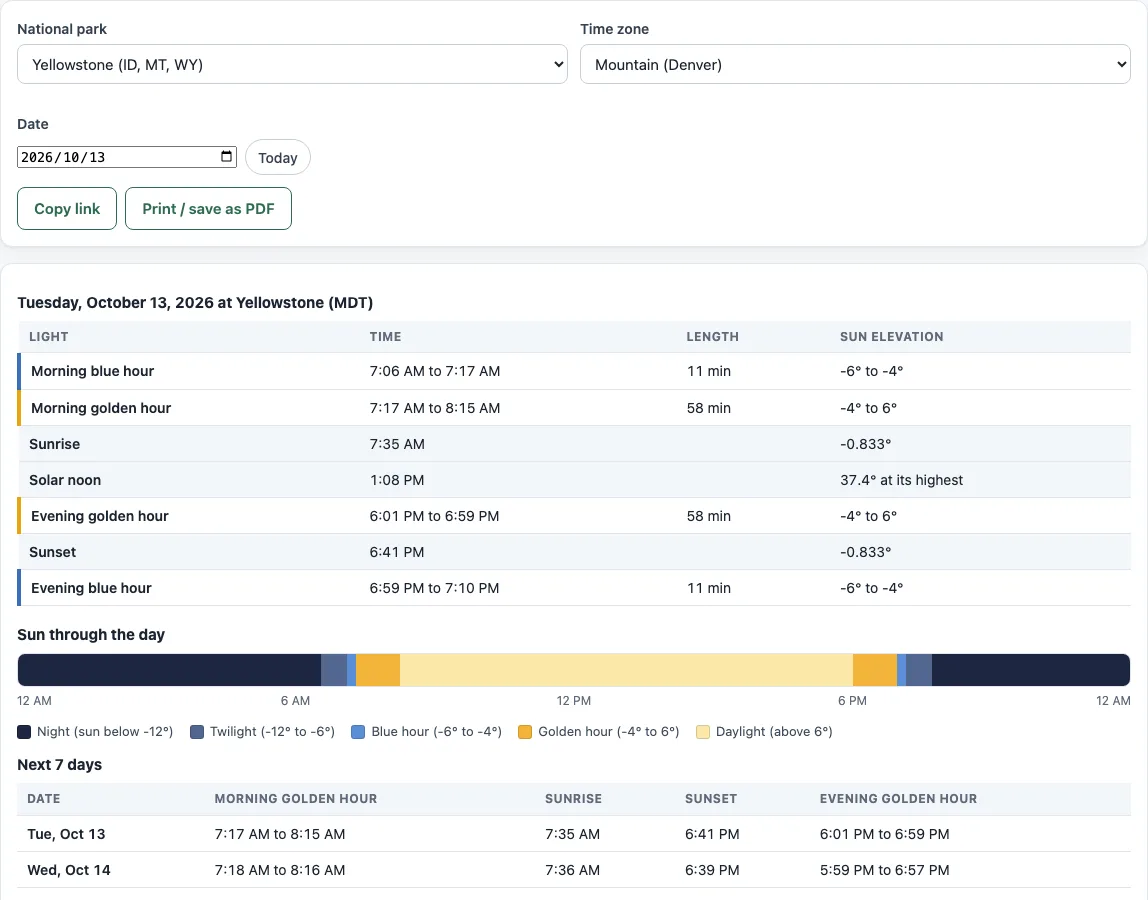
- Read the “Light times” table. Each row shows a “Time” span, a “Length” and the “Sun elevation” limits. Rows run in time order, from “Morning blue hour” to “Evening blue hour”.
- Scroll down to “Sun through the day” to see the whole day as a bar, and to “Next 7 days” to compare the coming week.
Press “Copy link” to copy an address that holds the place, time zone and date, so you can open the same view later. Press “Print / save as PDF” to keep a copy of the table.
Change the date to see another day; the “Next 7 days” table always starts from the date you set.
What is the difference between golden hour and blue hour?
Golden hour is the time when the sun sits between -4° and +6° of elevation, so its light is warm and low. Blue hour is the time when the sun sits between -6° and -4°, just below the horizon, when the sky takes on a deep blue tone.
Both are defined by the sun’s height, not by the clock. The sun crosses those angles at different moments each day, so the spans shift through the year. The page works out the crossing times from the sun’s position, using equations from Jean Meeus’s Astronomical Algorithms that follow the NOAA Solar Calculator method.
Blue hour has no official definition. Golden hour does not have one either. Photographers use the -4° to +6° range as a common convention, and other tools use other limits. The “Definitions used” box on the page states the limits used here and links to the NOAA Solar Calculator.
Is golden hour the same as sunrise and sunset?
No. Sunrise and sunset are single moments, when the sun’s center is at -0.833°. That figure allows for atmospheric refraction, which lifts the sun’s image above its true position, and for the sun’s apparent size. Golden hour is a span that wraps around them. In the morning it starts when the sun reaches -4°, before sunrise, and ends when it reaches +6°, after sunrise. In the evening the order reverses: it starts at +6° and ends after sunset.
In Washington DC on June 21, 2026, sunrise is 5:43 AM and golden hour runs from 5:24 to 6:23 AM. The light starts about 20 minutes before sunrise and lasts about 40 minutes after it. The page rounds every time to the nearest minute and shows it in the chosen zone.
Near the summer solstice at northern US latitudes the evening golden hour starts later and ends later than in winter, and at high latitudes it lasts much longer, because the sun crosses the horizon at a shallow angle. The “Next 7 days” table shows how quickly the times move from one day to the next at the place you chose.
Frequently asked questions
What time is golden hour today?
Choose your place, and the date already shows today in the chosen time zone. The “Light times” table lists the morning and evening golden hour as start and end times. In Washington DC on June 21, 2026, the morning golden hour is 5:24 to 6:23 AM EDT.
How long is golden hour?
By the -4° to +6° definition, golden hour is about an hour at mid-latitudes. In Washington DC it runs 59 to 61 minutes through the year. It is shorter near the equator, about 40 minutes at an equinox, and much longer at high latitudes in summer.
When is golden hour for sunrise and sunset in a national park?
Pick the park from the “National park” list, and the page sets that park’s time zone for you. Grand Canyon, Petrified Forest and Saguaro use Arizona time, which does not change for daylight saving time, except on the Navajo Nation. Park positions use the published center point from the NPS unit list, so a trailhead far from that point can differ by a minute or two.
Does golden hour exist in Alaska in summer?
Yes, but it behaves differently. In Anchorage on June 21, 2026, the sun only sinks to -5.3°, so golden and blue light last for hours around midnight. In Utqiagvik, Alaska, the sun does not set on June 21, and the page shows a note in place of a sunset time.
Why does my golden hour differ from another site’s?
Other sites use other elevation limits, such as 0° to +6° or -6° to +6°, and no official standard settles the choice. This page uses -4° to +6° for golden hour and -6° to -4° for blue hour, and the “Definitions used” box states that. Compare the limits first before you compare the times.
Is my location sent to anyone?
No. The page makes no network requests after it loads, and everything runs in your browser. If you press “Use my location”, the position is used on your device only.
Related tools
- Sunrise and sunset calendar: use it when you want sunrise and sunset times laid out by date.
- Bortle dark sky scale: use it to judge how dark the sky is at a site once the golden hour ends.
- National parks map: use it to see where each park sits before you pick one.
- Campgrounds near me: use it to find somewhere to stay near a park you plan to shoot in.
- Travel itinerary template: use it to fit golden hour times into a day-by-day trip plan.