Sunrise and Sunset Schedule Calendar
Choose a place and a month or a whole year to get a printable table of sunrise, sunset, day length and twilight for every day.
Recent
Your last 10 settings, saved only in this browser. Nothing is uploaded.
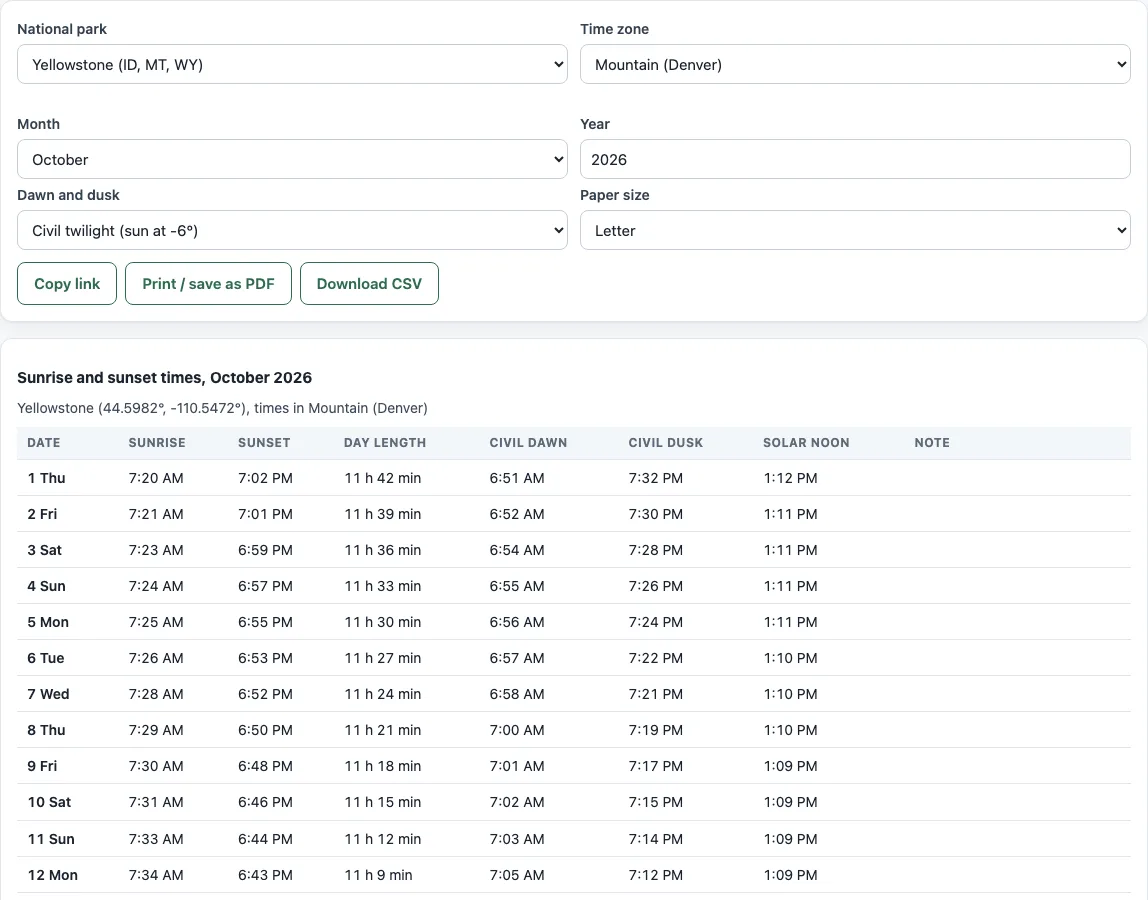
A sunrise sunset schedule lists the time the sun rises and sets on each day of a month or a year at one place. This free sunrise sunset calendar builds that schedule as a table for any place you choose, whether a national park, a latitude and longitude, or your own location. Each day gets a row with sunrise, sunset, day length, dawn and dusk, and solar noon, so you can see how the daylight changes across the month.
The calendar runs in your browser, with no sign-up. Nothing you type is sent anywhere. You can view one month or a whole year, then print the tables, download a CSV file, or copy a link that keeps your settings. The times are calculated for a flat horizon, so they do not account for hills, buildings or weather.
How to use the Sunrise and sunset calendar
- Choose a place. Pick a park from the “National park” list, or choose “Type latitude and longitude” and enter “Latitude” and “Longitude”. Use north-positive latitudes and east-positive longitudes; US longitudes are negative.
- Or click “Use my location”. Your location is used on this device only.
- Check the “Time zone”. A park selects its zone for you.
- Pick a “Month” from January to December, or choose “Whole year”.
- Enter a “Year” from 1900 to 2100. The default is the current year.
- Choose “Dawn and dusk”: “Civil twilight (sun at -6°)”, “Nautical twilight (sun at -12°)” or “Astronomical twilight (sun at -18°)”.
- Pick “Paper size”, “Letter” or “A4”, then select “Print / save as PDF” or “Download CSV”.
“Copy link” saves your place, year, month, twilight and paper choices in the address bar, so you can return to the same table or send it to someone. “Print / save as PDF” prints only the month tables, one month per page. “Download CSV” gives one row per day with 24-hour times, which opens in a spreadsheet. Anything this tool produces may be printed, shared and used for any purpose, including in classroom materials or in products for sale, royalty-free and without credit.
What time is sunrise and sunset today / this month?
Today’s row is underlined in the table, so you can find today’s times by opening the month that contains today’s date. Each day in the month has its own row, with times in the chosen time zone on a 12-hour clock, rounded to the nearest minute. Over a month the times shift steadily, so comparing the first and last rows shows the trend.
How do I get a sunrise sunset calendar for my location?
The table depends on three things: latitude, longitude and time zone. Latitude controls how much the day length changes over the year, and longitude together with the time zone sets the clock time of sunrise and sunset. A park preset supplies all three from the NPS list. There is no ZIP-code lookup, because a ZIP code needs a database, so type coordinates or share your location instead.
Can I print a sunrise sunset calendar?
Yes. The printed pages come from the same calculation as the screen table, so the times match. The paper choice of Letter or A4 sets the page format, and each month starts on a new page. Print the months you need one at a time.
Can I open the schedule in a spreadsheet?
The CSV file is a plain text table, and any spreadsheet program can open it. Times are in 24-hour HH:MM format and day length is in H:MM, so you can sort, filter or chart the values. This page does not create calendar subscriptions, so the CSV is a file you open yourself.
What is civil, nautical and astronomical twilight?
Twilight is the time when the sun is below the horizon but still lights the sky. Civil twilight begins or ends when the sun is 6° below the horizon, which gives enough light for outdoor activity without artificial light. Nautical twilight, at 12°, is when the horizon is hard to see at sea, and astronomical twilight, at 18°, is when the sky is fully dark. Sunrise and sunset use a different point: the sun’s center sits 0.833° below a flat horizon, which allows for refraction and the sun’s radius.
Why is the earliest sunrise not on the longest day?
Solar noon, when the sun is highest, is not at 12:00, and its clock time shifts through the year because of the equation of time. In Washington DC in 2026, the earliest sunrise (5:42 AM) first appears on June 10, and the latest sunsets (8:38 PM) come in the last days of June, while June 21 has the longest day at 14 h 54 min. On June 21, solar noon in Washington DC is 1:10 PM EDT.
Why does the table show a shaded row?
A shaded row marks a day when clocks change in the chosen time zone, with a note reading “Clocks go forward 1 hour” or “Clocks go back 1 hour”. In 2026, US daylight saving time starts on Sunday March 8 and ends on Sunday November 1. Arizona (except the Navajo Nation) and Hawaii do not change clocks, so their rows are not shaded for those dates. On a shaded day the sun has not changed; only the clock has.
Frequently asked questions
Are the times accurate?
The calculations were verified within one minute against the U.S. Naval Observatory (USNO) for several places, including Washington DC on June 21, 2026, with sunrise at 05:43 and sunset at 20:37. The method follows the NOAA Solar Calculator, based on Jean Meeus’s Astronomical Algorithms. Times are rounded to the nearest minute.
Does it account for mountains, buildings or weather?
No. The calculation uses a flat horizon, so at a mountain site the real sunrise comes later than the table shows.
Can I get a sunrise sunset calendar by ZIP code?
No. A ZIP code lookup needs a database, which this tool does not have. Type latitude and longitude, use “Use my location”, or pick a national park.
Which years does the sunrise sunset calendar cover?
It covers 1900 to 2100, so past years work the same way as the current year. Old and future years use present-day equations, which are accurate to well under a minute.
What happens when the sun stays up or down all day?
Days with no sunrise or sunset show dashes, with the note “Sun up all day” or “Sun down all day”. Day length then reads 24 h 0 min or 0 h 0 min. For example, the sun does not set at Utqiagvik, Alaska on 2026-05-12 or 2026-06-21, and it does not rise on December 21.
Can I use the printable for commercial purposes or sell it on Etsy?
Yes. What the tool produces may be used for any purpose, including in products for sale such as printables or printed planners, royalty-free and without credit. The only limit is that you may not copy the website or tool itself as a competing service.
Is my location sent anywhere?
No. Everything runs in your browser, and nothing you type is sent anywhere. If you press “Use my location”, the position is used on your device only, and the page makes no network requests after it loads.
Related tools
- Golden hour calculator: use it to find the warm light window before sunset or after sunrise.
- Bortle dark sky scale: use it to judge how dark a site is once you know when astronomical twilight ends.
- National parks map: use it to find a park before choosing its preset here.
- Campgrounds near me: use it to find a place to stay for the dates you plan.
- Travel itinerary template: use it to add sunrise and sunset times to a trip plan.